
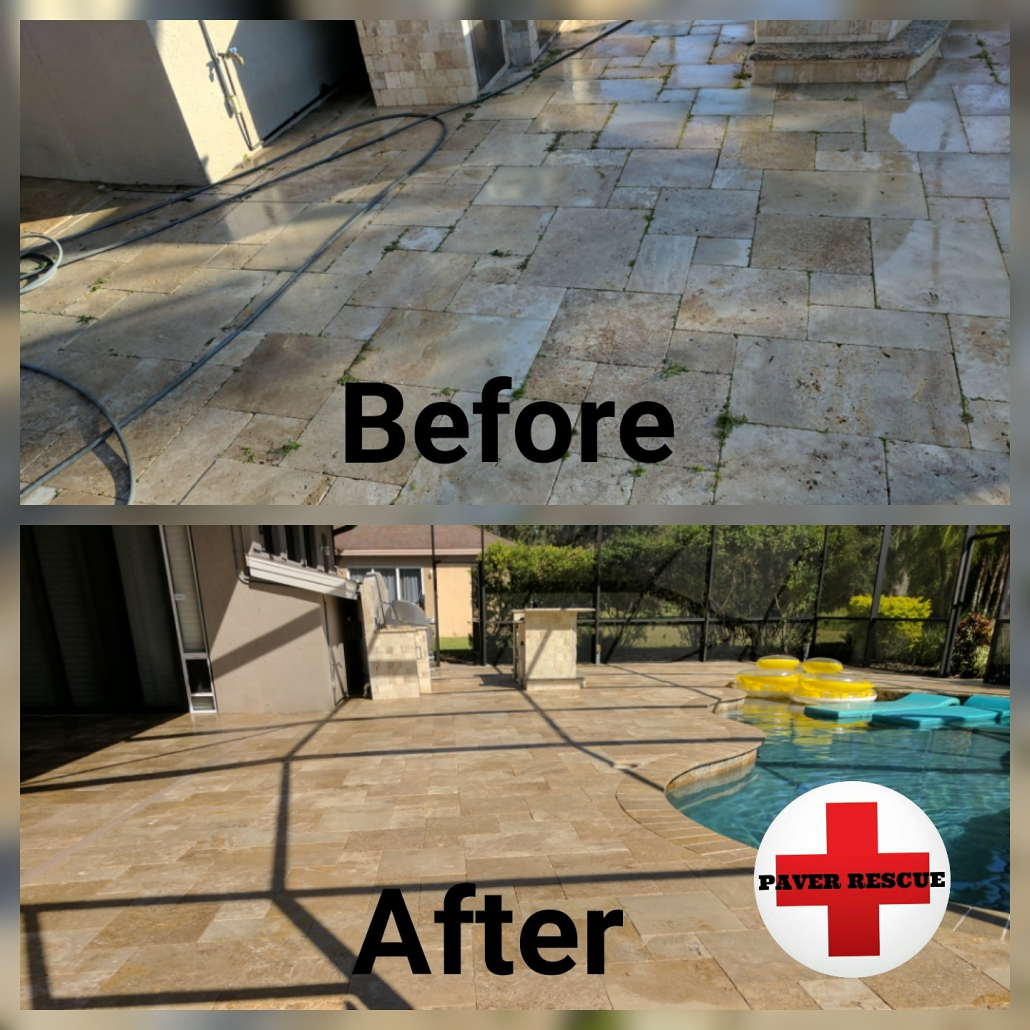
Late-season storms in Clearwater bring heavy rain, wind-driven salt, and rapid mold growth. Skip prep and you risk shifted pavers, dirty grout lines, and slippery travertine within weeks.
Quick seasonal checklist
- Inspect for loose or sunken pavers (DIY): walk the deck and press at least 20 points per 200 sq ft. Any movement greater than 1/8 inch needs repair so water won’t pool under the stone.
- Clear debris and drains (DIY): remove leaves, pool filters, and any loose sand near edge restraints. Clogged scuppers and channel drains cause standing water during a storm.
- Check and resand joints (DIY/pro): if joint sand is missing more than 1/4 inch or you can see the bedding material, add polymeric or kiln-dried sand and compact it; polymeric sand locks better against high winds and washout in heavy rain.
- Address efflorescence and mold (pro recommended): white haze or black streaks mean salts or biological growth. A professional cleaning with low-pressure detergents and neutralizing rinse removes deposits without etching travertine.
- Non-slip treatment for travertine (pro): on wet, smooth travertine, ask for a grit-infused sealer or a textured, non-slip finish. Coastal homes should use products rated for salt exposure.
- Apply sealer if conditions allow (pro): use a minimum of two coats of a water-based, film-forming sealer for color enhancement and stain resistance; wait for a 24–48 hour rain-free window and ambient temps between 50–90°F.
Inspect: what to look for and why it matters
Start with movement. Press each paver where feet land most. Shifting tells you the joint sand is gone or the edge restraint failed. If edges rock, the slab will let water run under the pavers and erode the base during a storm. Look for white efflorescence on brick pavers and dark green or black mold on travertine—those are active problems in Clearwater’s humid climate and salt spray areas.
For guided repair and resanding options in Clearwater, see Paver Repair and Resanding Services in Clearwater, FL.
Resanding: materials, timing, and DIY limits
Use polymeric sand for joints 1/16″–1/2″ wide and kiln-dried sand for very narrow joints. Polymerics harden when damp and resist washout, which matters when a tropical downpour can drop 1–3 inches of rain in a few hours. Compact the sand with a plate compactor or rubber mallet, sweep clean, then mist to activate. DIY is reasonable for small decks under 300 sq ft. Larger areas, uneven bases, or recurring washout need a pro who can re-establish the base and edge restraint.
Cleaning and sealing: timing and product choices
Pressure washing is step one, not the whole job. Use a low-pressure detergent wash on travertine to avoid etching. After cleaning, wait 7–14 days for efflorescence to release on newer installations; on older decks, let the surface dry 24–48 hours before sealing. In Tampa Bay’s humidity aim for a 48-hour dry window if possible. Choose a professional-grade water-based sealer applied in at least two coats—wet-look or matte finish is your choice, but non-slip additive is recommended for pool edges. Typical recoat interval is every 3–5 years; high UV and heavy pool traffic can shorten that to 2–3 years.
For travertine-specific services, see Travertine Pool Deck Sealing and Repair in Clearwater, FL.
Costs and observable warning signs
National average cost ranges: resealing runs about $0.50–$2.00 per sq ft depending on coat count and finish; resanding and joint work is commonly $0.30–$1.50 per sq ft; full restoration with base repair can be $6–$15 per sq ft. Local factors that push costs up in Clearwater include salt-air corrosion, large travel distances for crews, and the need for non-slip finishes near pools.
Warning signs to act on now: shifting or sunken pavers, sand washed out more than 1/4″, persistent dark algae in joints, white haze that won’t brush off, and a slippery surface when wet. Each indicates a different fix—resand, deep clean, re-bed, or apply a non-slip sealer.
Which tasks are DIY and which to hire a pro
DIY: debris clearing, basic inspection, small-area resanding under 300 sq ft, and applying non-slip broom finish with a hand sealer tool on a small budget job. Professional needed: base repair, efflorescence remediation, wide-area resanding, two-coat commercial sealing, and textured non-slip treatments on travertine. Pros also manage humidity-related timing and warranty-grade products.
If you want someone local to consult, Paver Rescue LLC serves Clearwater and surrounding Tampa Bay areas; you can reach them at 10810 Carrollwood Dr., Tampa, FL 33618 or by phone at 813-391-6159.
If you do nothing else, pick one spot by the pool that gets the most traffic and check the joint sand. Refill any gaps down to 1/4″ before the next storm.


Leave a Reply
Want to join the discussion?Feel free to contribute!