
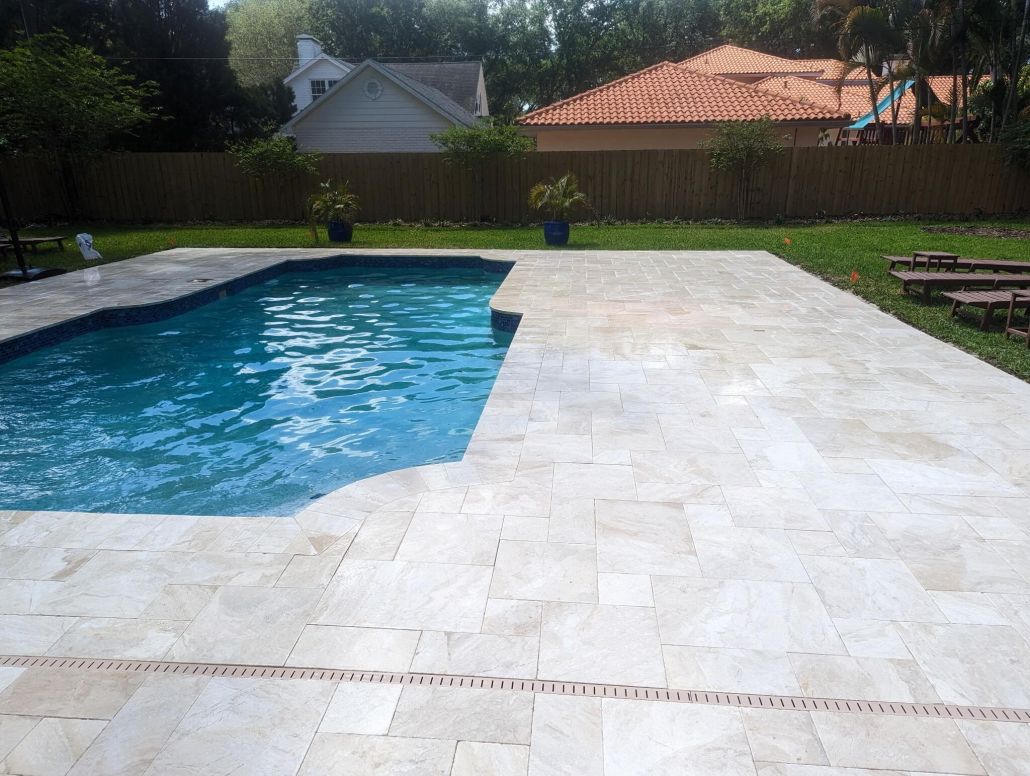
Late summer humidity and the first fall storms leave travertine pool decks in Land O Lakes looking dull, slippery, and stained. If you skip prep now, you’ll see mildew, white efflorescence, and joint sand gone after a wet week—problems that show up during a weekend of guests. Do this checklist in the next 2–3 weeks before the typical autumn rain pattern sets in.
Checklist: 6 steps to guest-ready travertine
- 1. Remove furniture and sweep the surface (DIY). Sweep or blow away loose debris and sand. Travertine traps grit in pits and honed finishes, and sand left on the surface grinds the finish when people walk on it.
- 2. Spot-treat stains and oil marks (DIY or pro for deep stains). For grease, apply a poultice made of baking soda and water and let it dry 24–48 hours before rinsing. Rust and deep organics often need a stronger, pH-neutral cleaner or a pro-grade treatment—consider a contractor if the stain won’t lift after one attempt.
- 3. Deep clean for algae and mildew (DIY with care; pro recommended for heavy growth). Use a mild, pH-neutral travertine cleaner and a soft-bristled scrub brush. Avoid high-pressure washing close to the stone face—pressure over 1,500 psi or a narrow nozzle can etch travertine and remove joint sand. For property-wide or commercial jobs in nearby Brandon or Wesley Chapel, consider a professional who can control pressure and runoff (Paver Cleaning and Pressure Washing in Wesley Chapel, FL).
- 4. Check joints and resand with the right material (DIY for small areas; pro for full decks). Use polymeric sand or a fine, washed masonry sand for travertine joints. In Tampa Bay’s rainy season, polymeric sand resists washout better than ordinary sand, but it must be applied dry and compacted, then misted to activate. If you see joint loss over more than 20% of the deck or shifting pavers, hire a pro for proper resanding and compaction (Paver Restoration and Repair Services in Tampa, FL).
- 5. Address efflorescence before sealing (pro recommended). White chalky residue is common on travertine in humid coastal areas and after heavy summer rains. Tell-tale sign: powdery white that brushes off but returns. A professional-grade efflorescence cleaner and repeated rinsing are usually needed. Sealing over active efflorescence traps salts and causes a cloudy finish.
- 6. Choose the right sealer and timing (pro recommended for even finish). For Florida travertine, a high-quality water-based, film-forming sealer in two coats gives UV protection and a wet-look or matte finish depending on product. Apply when surface temps are 50–90°F and humidity is lower—late morning on a dry day is ideal. Allow 24–48 rain-free hours to cure. Plan to recoat every 3–5 years; high-traffic or pool-chemical exposure shortens that interval. For nearby Lutz travertine decks, see advice specific to cleaning and sealing in Lutz (Travertine Paver Sealing and Cleaning in Lutz, FL).
Local climate details that change what you do
Land O Lakes sits in humid subtropical Florida. Afternoon storms and high humidity mean the surface rarely stays dry for long in late summer and early fall. That drives three concrete changes to your plan: wait for a 48-hour dry window after cleaning before sealing; prefer polymeric sand or edge restraints to keep joints stable during intense rains; and expect mildew to return faster near shaded lanai areas. If your deck faces the bay or a salt-air corridor, rinse the surface with fresh water monthly to reduce salt buildup that dulls the finish.
Costs, timing, and warning signs
Typical local price ranges: sealing alone usually runs $0.75–$2.50 per sq ft depending on coat count and surface prep; full restoration (clean, repair, resand, and two-coat seal) typically ranges $2.50–$6.50 per sq ft. New travertine installs have their own pricing; see local installation pages if you need a contractor in Land O Lakes.
Do this within 2–3 weeks before your entertaining date. Warning signs you’ve waited too long: shifting or sunken edges, joint sand that’s a quarter-inch or more below the surface, visible white efflorescence, and slippery dark patches that come back after cleaning. These mean you need restoration rather than a quick seal.
First thing to do if you do nothing else
Sweep and inspect the joints. If you can see the base or the joint sand is more than 1/4″ low, resand those areas first. Joint failure shows up as rocking pavers and rapid weed growth during fall rains; fixing joints is the single action that prevents most guest-day disasters.
For a professional estimate or help with heavy mildew and efflorescence on a travertine pool deck in Land O Lakes, contact Paver Rescue LLC at 10810 Carrollwood Dr., Tampa, FL 33618 or call 813-391-6159. Free estimates are available by phone.


Leave a Reply
Want to join the discussion?Feel free to contribute!