
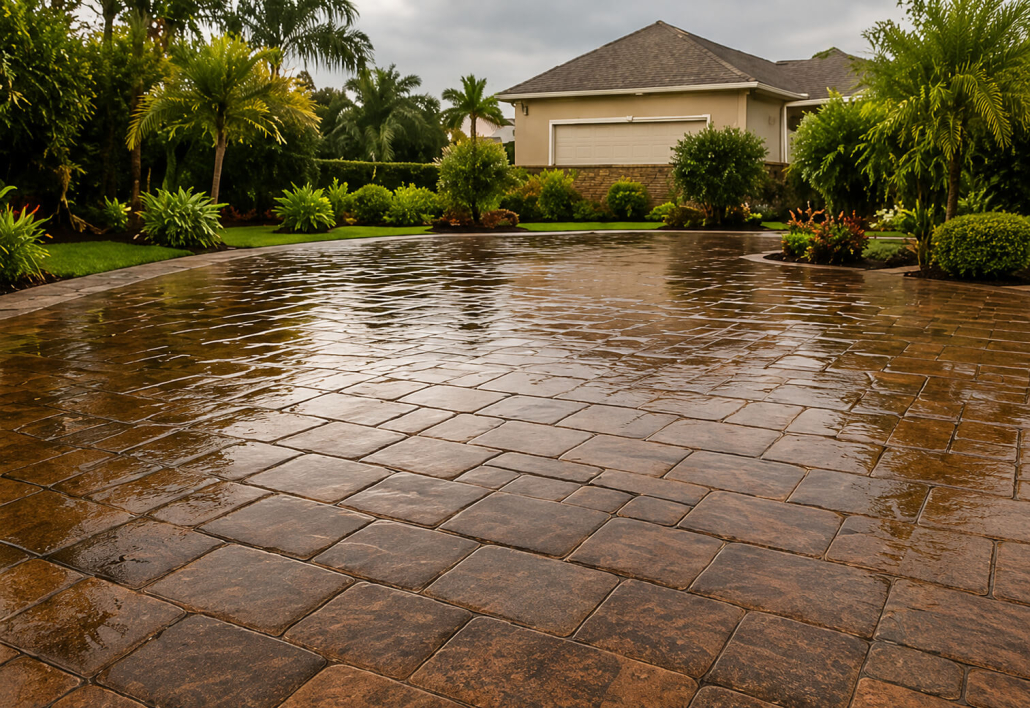
It matters now because Tampa Bay’s late-season storms come with heavy rain and strong runoff. If you skip prep, expect washed-out joints, shifting edges, and higher repair bills after the first hard downpour.
Quick checklist: what to do in the next 7–10 days
- Clear surface debris and drains (DIY) — Sweep leaves, seed pods, and pool chemicals away from drainage inlets and driveway slopes. Standing debris channels water into joints; remove it to keep runoff where it belongs.
- Check and refill joint sand (DIY or pro for large areas) — Look for joints that are down 1/8″–1/4″ or more. Use polymeric sand for better wash resistance in Tampa Bay’s heavy rains. Compact sand with a plate compactor or tamping block; loose joints let water lift pavers.
- Inspect edge restraints and high-traffic edges (Pro) — Soft or cracked edge restraints allow edges to pop under wave action from storm runoff. Have a contractor reseat or add a concrete curb where the driveway meets a lawn or gutter.
- Test for efflorescence and mold (DIY) — White haze or dark green patches mean salts or algae. Heavy efflorescence can indicate trapped moisture. Clean with a product suited for brick pavers or travertine; if stains persist, schedule professional cleaning and deep drying.
- Choose a quick-setting, water-based sealer if you plan to seal soon (Pro) — In October the rain window narrows. Use a professional-grade water-based film-forming sealer that cures within 24–48 hours of dry weather and gives UV protection. Avoid solvent-heavy products that can blush in humid air.
- Reslope and clear runoff paths (Pro or DIY for small fixes) — Check that water runs off the driveway into lawns or drains, not along the pavement edge. Regrade small low spots with bedding sand; for larger corrections, call a pro.
Why each step matters in Tampa Bay’s climate
Heavy afternoon storms and high humidity make washout a real risk. When joints lose 1/8″–1/4″ of sand, a single intense storm can wash out another 1/8″ in places that funnel water. Once joints open up, pavers shift and weeds take hold. Salt-air near Pinellas County speeds corrosion of metal edge restraints and can weaken unsealed travertine faster than inland locations.
Timing and product specifics
Wait for a 24–48 hour dry window before sealing. Aim to seal when air and surface temperatures are between 50°F and 90°F—typical in Tampa Bay in fall mornings. For joint sand, polymeric sand with fine silica and a stabilizer performs best against washout; expect it to set in 24 hours when it stays dry. For homeowners planning a new surface: wait 60–90 days after a new install before sealing, to allow initial efflorescence to release.
Costs, signs you need a pro, and local examples
Typical national cost ranges: sealing runs $0.75–$2.50 per sq ft depending on coat count and product; joint resanding is roughly $0.20–$0.60 per sq ft; repairs or edge restraint replacement vary widely, often $300–$1,200 for partial jobs. Local factors in Tampa Bay that raise costs: salt-air on coastal jobs, extra hauling for sediment after storms, and higher labor for weekday scheduling during hurricane season preparations.
Call a pro if you see one or more of these signs: shifting pavers along an edge, joints more than 1/4″ low, visible base material, widespread efflorescence, or standing water after normal rainfall. For professional cleaning before a season, our team details the process from small repairs to deep cleaning, resanding, and sealing on the service pages for nearby communities like Wesley Chapel and St. Petersburg.
Do this first: refill any joints that are visibly low. If you do nothing else, top up and compact the joint sand where it’s been washed away. It only takes a couple of hours for a typical 500–700 sq ft driveway, and it stops the worst washout during the first major storm.


Leave a Reply
Want to join the discussion?Feel free to contribute!